Quick answer: the IPC scales minimum slope with pipe size (¼″/ft ≤2½″, ⅛″/ft for 3″–6″, 1/16″/ft for 8″+). The UPC holds ¼″/ft for every size, allowing ⅛″/ft on 4″+ only with AHJ approval. Canada's NPC uses 1:50 (2%) up to 3″ and 1:100 (1%) above. On a 3″ line the IPC and UPC differ by a factor of two.
Three model codes govern drainage slope in North America, and they genuinely disagree — not on philosophy (keep ~2 ft/s of scouring velocity) but on where to draw the lines. If you work near a state line, bid in multiple jurisdictions, or just argue on the internet, this is the table to bookmark.
The full comparison table
| Pipe size | IPC 2024 | UPC 2024 | NPC 2020 (Canada) |
|---|---|---|---|
| 1½″ | ¼″/ft | ¼″/ft | 1:50 (≈¼″/ft) |
| 2″ | ¼″/ft | ¼″/ft | 1:50 (≈¼″/ft) |
| 2½″ | ¼″/ft | ¼″/ft | 1:50 (≈¼″/ft) |
| 3″ | ⅛″/ft | ¼″/ft | 1:50 (≈¼″/ft) |
| 4″ | ⅛″/ft | ¼″/ft * | 1:100 (≈⅛″/ft) |
| 5″ | ⅛″/ft | ¼″/ft * | 1:100 (≈⅛″/ft) |
| 6″ | ⅛″/ft | ¼″/ft * | 1:100 (≈⅛″/ft) |
| 8″ | 1/16″/ft | ¼″/ft * | 1:100 (≈⅛″/ft) |
| 10″ | 1/16″/ft | ¼″/ft * | 1:100 (≈⅛″/ft) |
| 12″ | 1/16″/ft | ¼″/ft * | 1:100 (≈⅛″/ft) |
| 15″ | 1/16″/ft | ¼″/ft * | 1:100 (≈⅛″/ft) |
* UPC exception: 4″+ pipe may be approved at ⅛″/ft (1%) by the Authority Having Jurisdiction where ¼″/ft is impractical.
The three places they actually disagree
1. The 3-inch line
The famous one. IPC says ⅛″/ft; UPC and NPC say ¼″/ft. Over a 20-ft toilet branch that's 2.5″ of fall versus 5″ — the difference between fitting in a joist bay and furring down a ceiling. Full details in the 3-inch drain guide.
2. Big pipe
At 8″ and up, the IPC relaxes to 1/16″/ft — deep commercial mains move enough water to scour at half a percent. The UPC never relaxes on paper; it routes big-pipe pragmatism through the AHJ-approval mechanism instead. The NPC lands in the middle at 1:100.
3. Who decides the exceptions
The IPC bakes its allowances into the table. The UPC pushes them to your inspector — which means under UPC you should plan the conversation, not just the trench. Get flat-slope approval in writing before relying on ⅛″/ft on a 4″+ line.
Which code am I under?
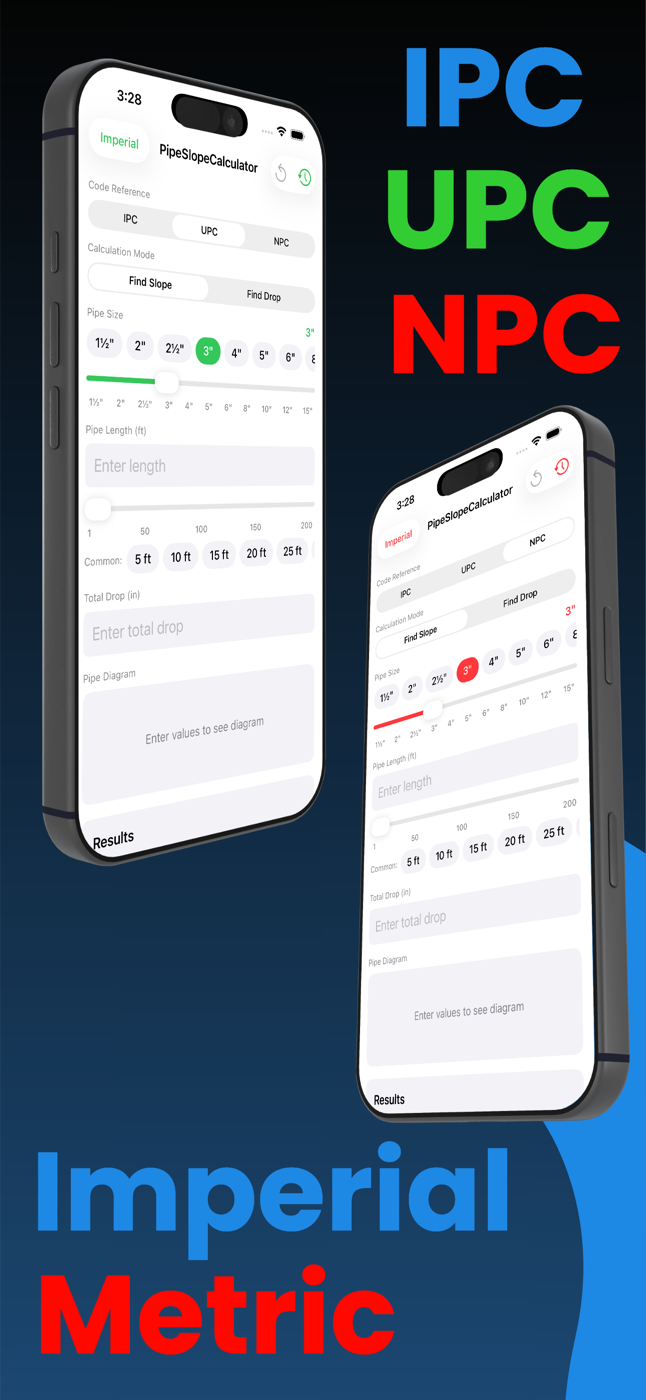
Plumbing codes are adopted state by state (province by province in Canada), often with amendments, sometimes city by city. As a broad orientation: the UPC (published by IAPMO) dominates the western U.S.; the IPC (published by ICC) forms the basis of most other state codes; the NPC applies across Canada with provincial variations. The only authoritative answer is your local permit office. The app makes the "which code" question cheap: switch codes with one tap and watch the minimums update.
Compare codes in the app
- Set up your calculation once — pipe size, length, slope or drop.
- Tap IPC → UPC → NPC across the top. The compliance check re-runs instantly against each code's minimum for your pipe size.
- The accent color follows the code (blue IPC, green UPC, red NPC) so screenshots and history entries stay unambiguous.
- Each result links the code section it checked against — IPC 2024 §704.1, UPC 2024, NPC 2020 — for the inspector conversation.
Reference only: this table reflects the model codes; adopted versions and amendments vary by jurisdiction and year. Your local AHJ has the final word.
Related questions
Which states use the IPC vs the UPC?
Broadly: UPC in the West, IPC-based codes in most other states — adopted state by state with frequent amendments. Ask your permit office which edition applies.
Is the UPC stricter on slope?
For 3″+ pipe, yes — ¼″/ft everywhere vs the IPC's ⅛″ and 1/16″ tiers. They agree at ¼″/ft for 2½″ and smaller.
What does Canada's NPC require?
1:50 (2%) for 3″ and smaller, 1:100 (1%) for 4″ and larger. See the metric gradient guide for working in 1:X notation.
All three codes in your pocket
IPC, UPC and NPC minimums for every pipe size, checked automatically. Offline, $2.99 once.