Quick answer: under the IPC, a sewer line needs ¼ inch of fall per foot of run for pipe up to 3″, and ⅛ inch per foot for 4″ and larger pipe. A typical 4″ residential sewer that runs 50 feet therefore needs at least 6.25 inches of total fall from the house to the connection point.
"Fall" is the vertical distance a sewer line drops over its horizontal run — the same thing as slope or pitch, just expressed as a total. Get it right and gravity does the work for decades. Get it wrong in either direction and you're renting a drain machine on a schedule: too little fall and solids settle out; far too much on a shallow grade and liquids can outrun solids (see maximum slope for drain pipe).
Fall per foot by pipe size
| Sewer pipe size | IPC 2024 minimum | UPC 2024 minimum | NPC 2020 (Canada) |
|---|---|---|---|
| 3″ | ⅛″/ft | ¼″/ft | 1:50 (≈¼″/ft) |
| 4″ (most homes) | ⅛″/ft | ¼″/ft* | 1:100 (≈⅛″/ft) |
| 6″ | ⅛″/ft | ¼″/ft* | 1:100 (≈⅛″/ft) |
| 8″+ | 1/16″/ft | ¼″/ft* | 1:100 (≈⅛″/ft) |
* UPC: 4″+ pipe may be approved at ⅛″/ft by the Authority Having Jurisdiction where ¼″/ft is impractical. Local amendments to sewer rules are common — always verify.
Total fall chart (how much drop over your run)
Total fall = run length (ft) × slope (in/ft). Here's the math done for common runs:
| Run length | At ⅛″/ft (1%) | At ¼″/ft (2%) |
|---|---|---|
| 10 ft | 1.25″ | 2.5″ |
| 20 ft | 2.5″ | 5″ |
| 30 ft | 3.75″ | 7.5″ |
| 40 ft | 5″ | 10″ |
| 50 ft | 6.25″ | 12.5″ |
| 75 ft | 9.4″ | 18.75″ |
| 100 ft | 12.5″ | 25″ |
Worked example: 50-foot house-to-main sewer
Say the invert (the inside bottom of the pipe) leaves the house at a set depth and the city tap is 50 feet away. Under the IPC on 4″ pipe:
- Minimum fall: 50 ft × ⅛″/ft = 6.25″
- Comfortable target: 50 ft × ¼″/ft = 12.5″ — a common choice when depth allows, and required outright under the UPC unless your AHJ approves less.
If the available elevation difference between your exit point and the connection is less than the minimum fall, that's when you're into re-grading, a deeper tap, or (worst case) a sewage ejector — better to find out with a calculator than with a transit after the trench is dug.
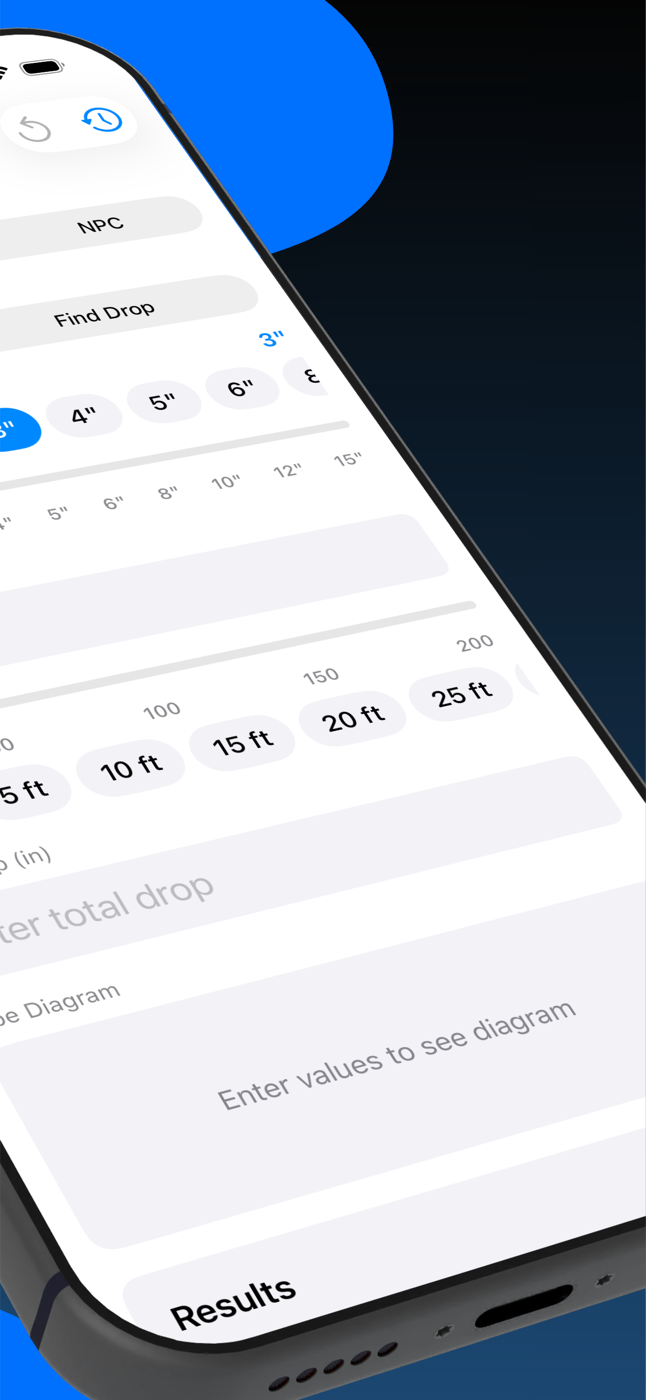
Get your sewer fall in seconds with the app
- Set the code (IPC, UPC or NPC) and tap your pipe size — e.g. 4″.
- Choose Find Drop mode.
- Enter your run length (there are one-tap presets for 5–25 ft, plus a slider up to 200 ft).
- Pick a slope preset (⅛″/ft, ¼″/ft…) or drag a custom value — the app instantly shows total drop, grade % and code compliance for that pipe size.
- Tap Copy Results to paste the numbers into a text to the excavator, or Save to History for the job file.

Reference only: sewer depth, frost lines, cleanout spacing and local amendments all affect the final design. Verify with your local Authority Having Jurisdiction before excavation.
Related questions
How much fall does a sewer line need over 50 feet?
At ⅛″/ft (IPC minimum for 4″ pipe): 6.25″ of fall. At ¼″/ft: 12.5″. Multiply run length in feet by slope in inches per foot.
Can a sewer line be too flat?
Yes. Below code-minimum slope, wastewater can't reach the ~2 ft/s velocity needed to carry solids, so waste settles and the line clogs repeatedly — and the installation fails inspection.
Do I measure sewer fall from the house or the street?
Fall is measured along the pipe run between its two ends — typically from the building drain exit to the main or septic connection. Every horizontal segment must hold at least the minimum uniform slope toward the point of disposal.
Fall, slope and drop — before the trench is dug
Pipe Slope Calculator does this math instantly and checks it against IPC, UPC and NPC. Works 100% offline.