Quick answer: the model codes set minimum slopes, not a general maximum — and piping graded at 45° or steeper is simply treated as vertical, which is always allowed. The practical field guideline is to keep horizontal drains carrying solids between ¼″ and ½″ per foot, and some local authorities do publish their own maximum-pitch rules.
"Too much slope makes the water outrun the solids" is one of the most repeated lines in plumbing — and it's both a real phenomenon and an over-applied myth. Here's the honest version.
What the codes actually say
- IPC and UPC: both specify minimum slopes per pipe size (see the minimum slope chart) and neither sets a blanket maximum for horizontal drainage.
- The 45° rule: once a pipe's grade reaches 45 degrees, codes treat it as vertical piping — and vertical drops (stacks) obviously work fine. So there's no physics ceiling on steepness itself.
- Local exceptions exist: a handful of jurisdictions cap building-sewer pitch (New York City's rules are the famous example) to protect the public sewer from high-velocity inflow. This is exactly the kind of thing your AHJ decides.
Where the "too steep" problem is real
The genuine trouble zone is a long run at a steep-but-shallow grade — say 1″–2″ per foot over many feet. In that band, the stream flows fast but stays shallow, so it can thin out around solids instead of pushing them. Symptoms are familiar: paper snakes stranded mid-run, grease shelves, repeat service calls on a line that "has plenty of fall."
Two clean ways to lose a lot of elevation without living in that band:
- Step it down: run at a normal ¼″/ft grade, then drop with 45° fittings or a vertical section, then resume normal grade.
- Treat it as vertical: where the drop is 45° or steeper, it's a stack — fine by code, with its own fitting rules.
The safe band, summarized
| Slope | Verdict for horizontal drains carrying solids |
|---|---|
| Below code minimum (e.g. <¼″/ft on 2″ pipe) | Not allowed — solids settle, line clogs, fails inspection |
| ¼″ – ½″ per foot | The comfort zone — scouring velocity with margin |
| ½″ – ~6″ per foot (long runs) | Legal under model codes, but the solids-stranding band — avoid long runs here; step down instead |
| 45° and steeper | Treated as vertical piping — allowed, follows stack rules |
Always check whether your local authority imposes its own maximum pitch for building sewers.
Stay in the band with the app
- Set your pipe size and code — the app knows the minimum side of the band automatically.
- In Find Slope mode, enter your run and available drop. If the result comes in hot (say 0.75 in/ft over 30 ft), you'll see it instantly in in/ft and percent.
- Use the slider or presets (up to 1″/ft) to test a stepped layout: what does the run look like at ¼″/ft, and how much drop is left over for a 45° step-down?
- Save both scenarios to History and compare before you cut pipe.
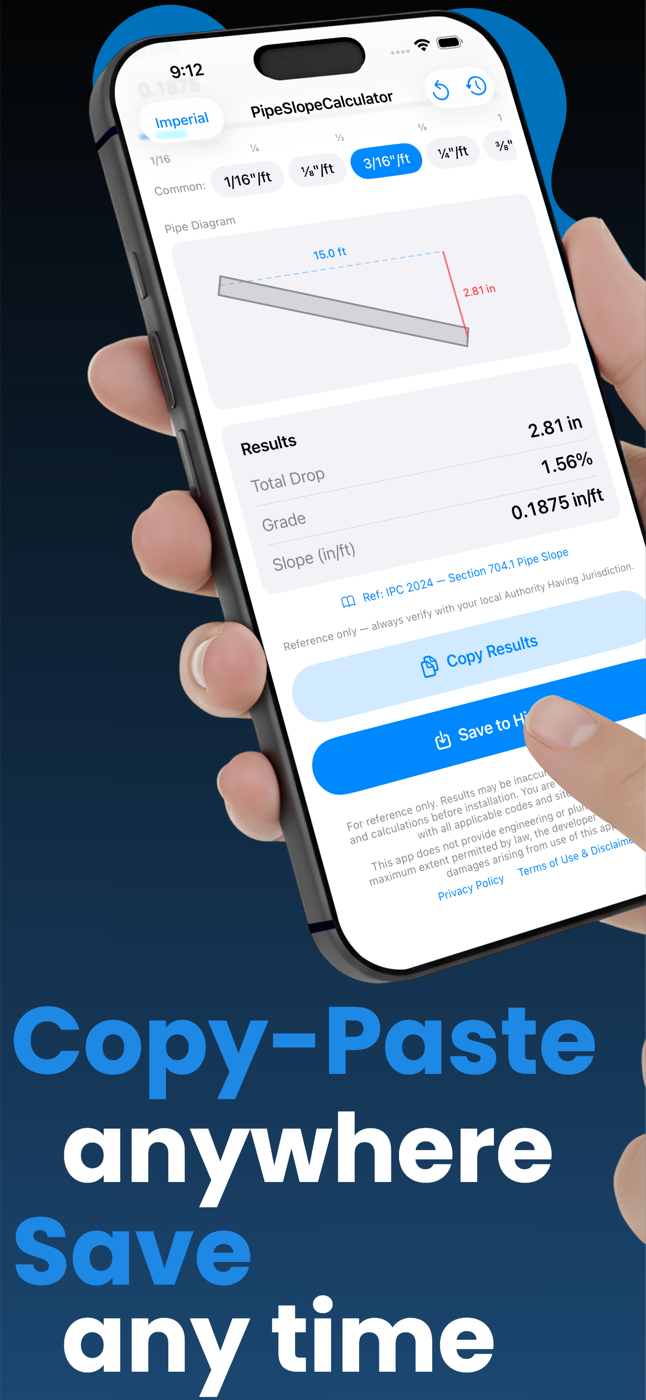
Reference only: maximum-pitch rules are local where they exist at all. Confirm with your Authority Having Jurisdiction — especially for building sewers connecting to a public main.
Related questions
Can a drain pipe have too much slope?
Codes set minimums, not a general maximum; 45°+ counts as vertical. The real caution zone is long, shallow-graded steep runs — step the elevation down instead.
Is ½ inch per foot too much?
No — it's generally considered the top of the comfortable ¼″–½″/ft band for horizontal drains carrying solids.
What happens if a sewer line is too steep?
Very steep shallow grades can strand solids, and some jurisdictions cap building-sewer pitch to protect the public main. Use 45° step-downs or a vertical drop for big elevation changes.
Find the slope that's just right
Minimums checked automatically, any custom slope testable in seconds. Offline, no ads, $2.99 once.