Quick answer: under the International Plumbing Code (IPC), horizontal drain pipe 2½″ and smaller needs ¼ inch per foot of slope, 3″–6″ pipe needs ⅛ inch per foot, and 8″ and larger needs 1/16 inch per foot. The UPC requires ¼ inch per foot at every size (with a 4″+ exception), and Canada's NPC requires 1:50 up to 3″ and 1:100 above.
"Minimum slope" (also called minimum pitch, fall or grade) is the least downhill angle a horizontal drainage pipe may legally have. It exists for one reason: wastewater has to move fast enough — roughly 2 feet per second, the industry's scouring velocity — to carry solids along with the liquid. Flatter than the minimum and solids settle out; the line clogs over and over, and the installation fails inspection.
Minimum drain pipe slope by size and code
The three major North American plumbing codes set the minimum slope by pipe diameter:
| Pipe size | IPC 2024 (§704.1) | UPC 2024 | NPC 2020 (Canada) |
|---|---|---|---|
| 1½″ | ¼″/ft (2.08%) | ¼″/ft (2%) | 1:50 (2%) |
| 2″ | ¼″/ft (2.08%) | ¼″/ft (2%) | 1:50 (2%) |
| 2½″ | ¼″/ft (2.08%) | ¼″/ft (2%) | 1:50 (2%) |
| 3″ | ⅛″/ft (1.04%) | ¼″/ft (2%) | 1:50 (2%) |
| 4″ – 6″ | ⅛″/ft (1.04%) | ¼″/ft (2%)* | 1:100 (1%) |
| 8″ – 15″ | 1/16″/ft (0.52%) | ¼″/ft (2%)* | 1:100 (1%) |
* UPC exception: where ¼″/ft is impractical (long runs, existing structural conditions), pipe 4″ and larger may be run at ⅛″/ft (1%) — but only with approval from the Authority Having Jurisdiction (AHJ).
Notice the pattern: the bigger the pipe, the flatter it's allowed to be. A larger pipe carries a deeper stream of water for the same fixture load, which keeps velocity up even on a gentler grade. That's why a 2″ shower branch needs ¼″/ft while a 4″ building drain can legally run at ⅛″/ft under the IPC.
Which code applies to you?
It depends on what your state, province or municipality has adopted. Broadly: the IPC is the basis for plumbing codes in most U.S. states, the UPC dominates the West (and is the strictest on slope), and the NPC is the model code across Canada. Local amendments are common — the table above is the starting point, and your local AHJ always has the final word. For a deeper comparison, see IPC vs UPC vs NPC slope requirements.
Worked example: 3″ branch drain, 12-foot run
- IPC: minimum ⅛″/ft × 12 ft = 1.5″ of total drop
- UPC / NPC: minimum ¼″/ft × 12 ft = 3″ of total drop
Same pipe, same run — double the required drop depending on the code. That difference decides whether the line clears a joist bay or needs to be re-routed, which is exactly why it's worth checking before cutting.
Check your slope against code in the app
Pipe Slope Calculator has all three code tables built in, so you don't need to memorize any of the numbers above:
- Open the app and pick your governing code — IPC, UPC or NPC — at the top.
- Tap your pipe size (1½″ through 15″).
- Enter the run length and either the drop you have (Find Slope) or the slope you're planning (Find Drop).
- Read the result: total drop, slope in in/ft, and percent grade. If the slope is below your code's minimum for that pipe size, the app shows a warning — including the UPC's 4″+ AHJ exception.
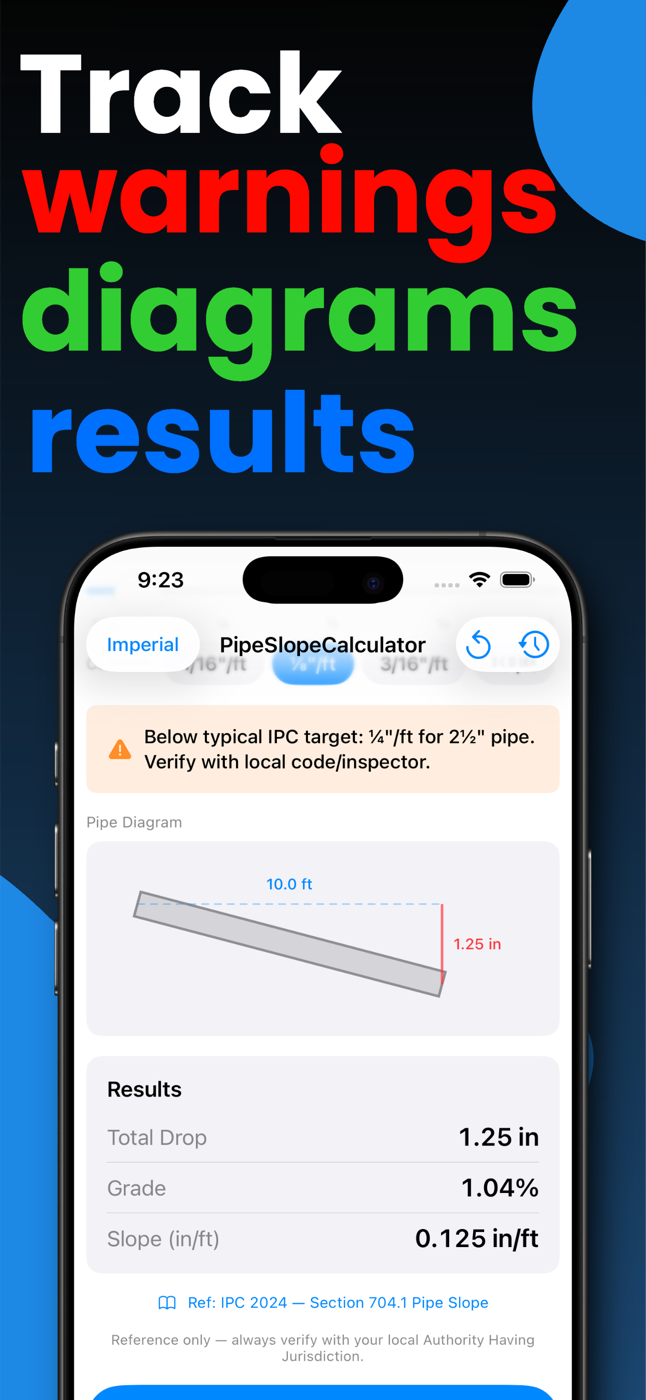
Reference only: code adoptions and local amendments vary. Always verify minimum slope with your local Authority Having Jurisdiction before installation.
Related questions
Is ⅛ inch per foot enough slope for a drain pipe?
Under the IPC, ⅛″/ft is the legal minimum for 3″–6″ pipe. Under the UPC it's only acceptable on 4″+ pipe with AHJ approval. For 2″ and smaller pipe, ⅛″/ft is below every major code's minimum.
What happens if a drain pipe doesn't have enough slope?
Wastewater moves too slowly to carry solids, so waste settles in the line and builds into recurring clogs. An under-sloped drain also fails inspection — which can mean re-doing the run after walls or slabs are closed.
Is drain pipe minimum slope the same as sewer pipe minimum slope?
The same code tables cover horizontal drainage piping generally, including building sewers — but many jurisdictions amend sewer rules locally. See how much fall a sewer line needs and always confirm with your AHJ.
Never look up a slope table again
Pipe Slope Calculator checks IPC, UPC and NPC minimums automatically. $2.99 once — works 100% offline.